


Currently there is no way to automate access to a Fluent Board, or link a Fluent Board to a company without a Company Custom Field. Currently, when we onboard a client, we:
-
Create a Fluent Board
-
Copy the Fluent Board Shortcode link and then paste it into a Fluent CRM Company custom field
-
On the client's contact we add them to the list 'Customer - User Account', and this triggers the automation that:
- creates their WP User account
- send them an email to reset their password
In future, it would be create to automate their access to a Fluent Board too by having an Fluent CRM action available to give them access to a companies board.

Environment : FluentCRM Pro + WooCommerce, variable product with 3 variations.
Setup : I have a variable product, with 3 variations : Standard, custom, custom ++.
I want a post-purchase automation that sends a customization fluent form email only when the customer buys the "customized" or "customized ++" variation.
Expected behavior : When a customer purchases the Standard variation → no email. When they purchase customized / customized ++ → send the customization form email.
What I'm running into — none of the native tools can target "the variation of the current order" :
- Trigger ("New Order – Processing") only lets me select the parent product via "Target Products" — variations are not selectable.
- Condition "Woo Order / Products in Order" references the current order but only lists the parent product, not its variations.
- Condition "Woo Variations / Purchased Product Variations" matches on the customer's full purchase history, not the current order. Consequence : a customer who bought a "customized" last year but a "Standard" today still matches "yes" → the form email goes out wrongly.
- WooCommerce product editor → FluentCRM tab : I can set purchase tags on the parent product, but not per variation.
What I need : a way to match the variation of the current order (the one that triggered the automation) — e.g. a field like "Woo Order / Variation purchased" or allowing variations in the trigger's "Target Products", or per-variation purchase tags.
Is there a native way I'm missing, or is this a known limitation? If so, is there an official workaround?

I'm starting this topic because I imagine many people here will be talking about it. Since yesterday, a new CRM has been launched on WordPress. I had never heard of this company, but I just discovered that they have several plugins, though with few active installs — notably a Bit Form plugin, Bit SMTP, Bit Social, etc. (none of them exceeds 10K installs).
And since yesterday: a CRM. This new CRM is called Bit CRM: https://bit-crm.com/
I discovered its release through this video: https://www.youtube.com/watch?v=mRp3ymZy39Y
They even made a page comparing it with FluentCRM: https://bit-crm.com/compare/fluentcrm-vs-bit-crm/
Basically, they've done what some of us have been recommending on FluentCRM: a real CRM. Because until now, FluentCRM has been more of an (and best in class) emailing and marketing automation tool rather than a complete CRM — as it's missing some features like lead management, deals/sales pipeline, company management and contacts organized by company, etc. Bit CRM has done it. FluentCRM can do it too 👍
Bit CRM looks well built. I haven't tested it, but the demo video is quite thorough. I think Bit CRM is a good model to follow. They even include management of products, meetings, calls, etc. I like the dashboard home displaying leads / contacts / companies / deals, deals pipeline, leads by source...
The current limitation of Bit CRM is that it only connects with WooCommerce, but their roadmap indicates they'll soon be integrated with FluentCart, SureCart, etc.
FluentCRM needs to catch up and become a complete CRM.
A CRM needs to manage and display the complete flow: capture leads (with FluentForms), manage leads / contacts / companies, manage deals via kanban / list view, manage products / services, manage invoices.
Bit CRM even includes standalone products / invoices management (outside any ecommerce plugin), but I think FluentCRM should be deeply integrated with FluentCart to show directly on a company profile: who the associated contacts are, what the company's invoices are, what total revenue has been billed to that company — and the ability to invoice directly from the company profile.
Two possible modes need to be distinguished: B2C and B2B. Those who only have B2C customers won't activate the B2B mode. But everyone who works with professional clients, agencies, etc. needs the B2B mode. You don't invoice a contact, you invoice a company.
What do you think?



Description:
Environment:
- FluentCRM 3.1.10
- Campaign created through the FluentCRM MCP
- Open and click tracking enabled
When a campaign is created through the MCP, the campaign settings are stored as:
open_tracker: "yes"
click_tracker: "yes"
These are strings rather than JSON booleans. The campaign report interface appears to require the strict boolean value true when determining whether tracking is enabled.
As a result, the report incorrectly states that open and click tracking were disabled for the campaign and hides or disables the View, Click and Unopened filters. However, tracking itself remains operational and open and click events continue to be recorded.
Steps to reproduce:
- Create a campaign through the MCP with open and click tracking enabled.
- Send the campaign and open its report.
- Observe the “tracking disabled” warning and the unavailable report filters.
- Inspect the campaign settings and confirm that both tracker values are stored as the string "yes".
- Change only those two values to the boolean true through the REST API.
- Reload the report.
Actual result:
The MCP stores string values. The report treats tracking as disabled, despite tracking events being recorded.
Expected result:
The MCP should store boolean values, consistently with the format expected by FluentCRM, or FluentCRM should normalize supported string values before evaluating them.
Verified workaround:
Changing only open_tracker and click_tracker from "yes" to true removes the warning and restores the report filters. It does not resend the campaign or alter its recipients, sent emails, opens, clicks or existing metrics.
I think there’s a need for updating the MCP schema or serializer to send JSON booleans for these fields. As an additional compatibility measure, FluentCRM could normalize "yes"/"no" values when loading campaign settings.

Because in MailerLite, SureCOntact, etc .I can do what I want. I downloaded the free version but I can only see pre made templates, I cant create my own automation.

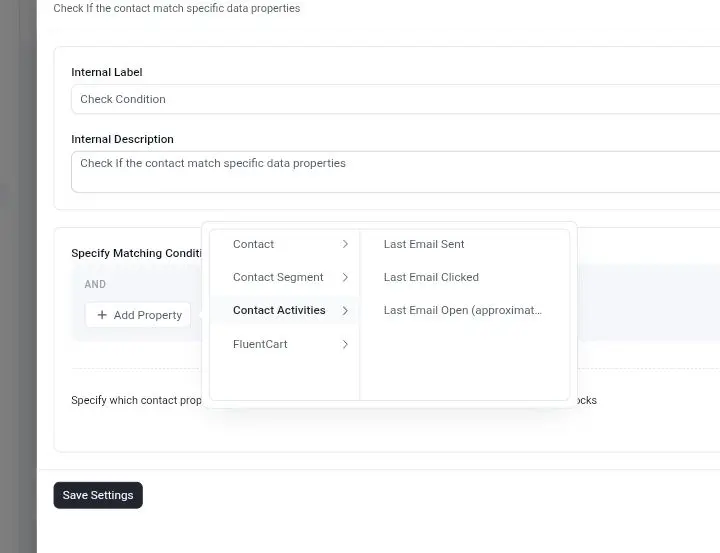
Would like to see SMS based data properties to help trigger condition similar to how emails do, especially with the contact activities properties like shown in the screenshot.

Has anyone examined using WPVibe.ai (or similar) as an MCP interface? The promise is that it will do everything that the Fluent MCP connections will do, along with interfacing with all the rest of the ai-aware plugins on the site.
On the surface it seems like a good abstraction layer across the entire site, minimizing the need to connect to each Fluent product MCP.

Is there any advantage to configure a direct connexion in Codex when the connection managed by wp works? I have a hard time configuring direct.