


It would be great if we could have 2-step checkout forms. Step 1: contact info, Step 2: payment info. Step 1 immediately save the info to CRM (also for abandonned cart purpose)

Hey, first - I LOVE EVERYTHING YOU DO! Two questions:
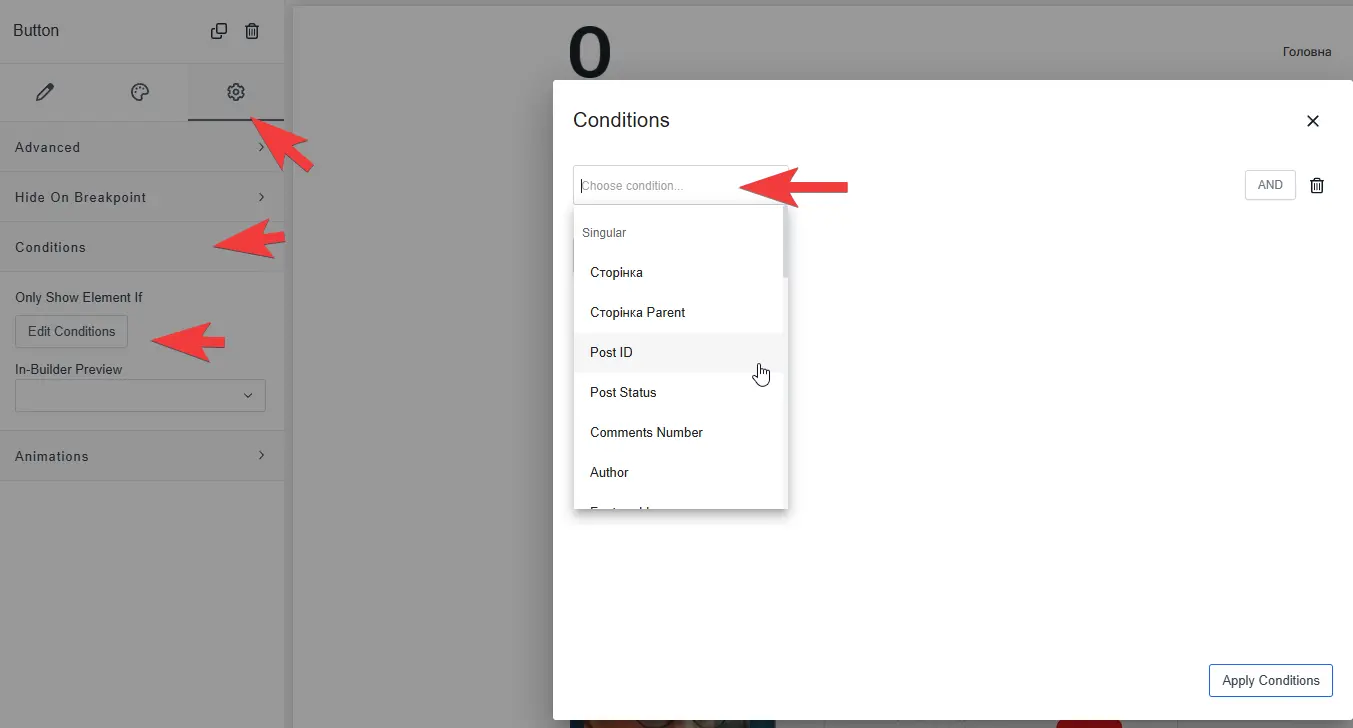
- any news on FluentCart and Breakdance integration? Elements and Conditions to show elements is the most interesting for me, anyone else?
- and what about Rankmath PRO (schemas and a lot of other PRO-features)- is it friendly to FluentCart?

TL;DR:
FluentCart is moving in the right direction, and the recent improvements around EU VAT/VIES validation are very welcome. It is clear that the team is putting a lot of care and attention into the product. Congrats!
However, I still cannot openly recommend it to many European digital businesses because there are important gaps around tax ID collection, VAT display, reverse charge wording, invoices/receipts, tax reports, refunds and manual orders.
These issues may not be obvious for merchants selling only inside their own country, but they become critical for businesses selling across the EU or internationally.
I really hope this feedback helps close some of those gaps.
Hi Jewel and team,
First of all, I’m happy to see the progress FluentCart is making. I have been testing it again from the perspective of European digital businesses that sell both locally and internationally, including B2B, B2C, EU and non-EU customers.
I will attach screenshots with specific examples, but I wanted to organize the main feedback here.
1. Checkout fields still need proper custom fields
Checkout fields still do not allow proper custom fields.
This is especially important for tax compliance. The Tax ID should be available as a required field by default, or at least easy to add next to the billing address fields.
The current EU VAT field helps when the customer is an EU business, but it does not solve the broader issue.
For example, a French store may sell to:
- a French company,
- a German company,
- a Spanish company,
- a US customer,
- a Canadian customer.
In the EU cases, the EU VAT field may apply. But for non-EU customers, the store may still need to collect a local tax ID, company registration number or equivalent fiscal identifier.
SureCart, for example, solves this with a single dynamic “Tax ID” field. Depending on the customer’s country, it can collect the relevant identifier.
Right now, unless I have missed something, FluentCart does not seem to offer a default way to request a tax ID outside the EU VAT configuration. This is a serious limitation for international compliance.
2. Price formatting should allow clean round numbers
This is not a major compliance issue, but it matters for UX and conversion.
If a product costs 50 €, some businesses may prefer to display it as:
50 €
instead of:
50,00 €
It would be useful to have an option to hide decimals when they are not needed.
3. EU VAT validation sometimes feels slow or unstable
When testing EU VAT numbers several times in a row, validation can take quite a while.
I also experienced a “Max concurrent request” error after entering VAT numbers two or three times in a row.
I understand this is not normal customer behavior in most cases, but it can happen with businesses managing different entities or establishments.
It would be useful to improve reliability, caching or user feedback around VIES validation.
4. “Reverse charge (No tax)” is confusing
I’m glad to see that FluentCart now references “Reverse charge” when an EU business enters a valid EU VAT number.
However, the wording “Reverse charge (No tax)” is not ideal.
The issue is the “No tax” part.
In a reverse charge scenario, the seller does not charge VAT to the customer, but this is not simply a “no tax” transaction. There is still a VAT treatment, and the buyer may have to account for VAT locally under the reverse charge mechanism.
The phrase “No tax” can confuse both sellers and buyers. I have already seen this create doubts in Spain and other EU member states.
I am not asking FluentCart to include the specific legal article in every case, because I understand this can vary depending on the country, product or service. But I do think “No tax” should be removed.
A safer wording would be simply:
Reverse charge
or:
Reverse charge applies
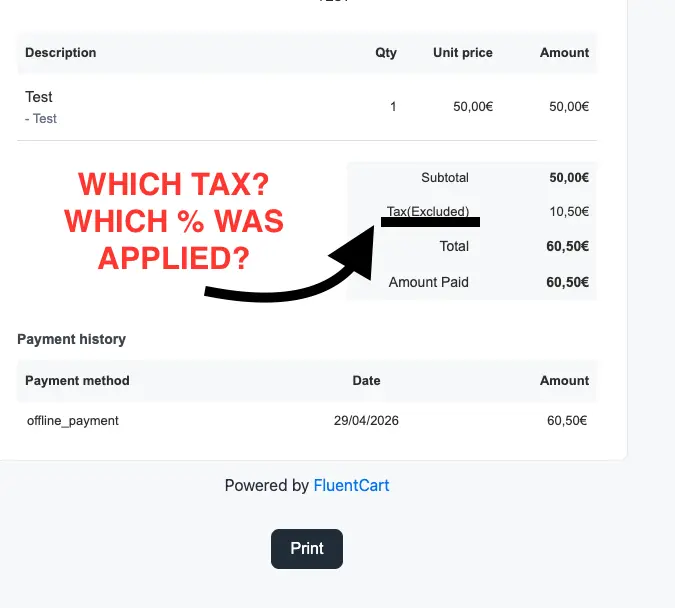
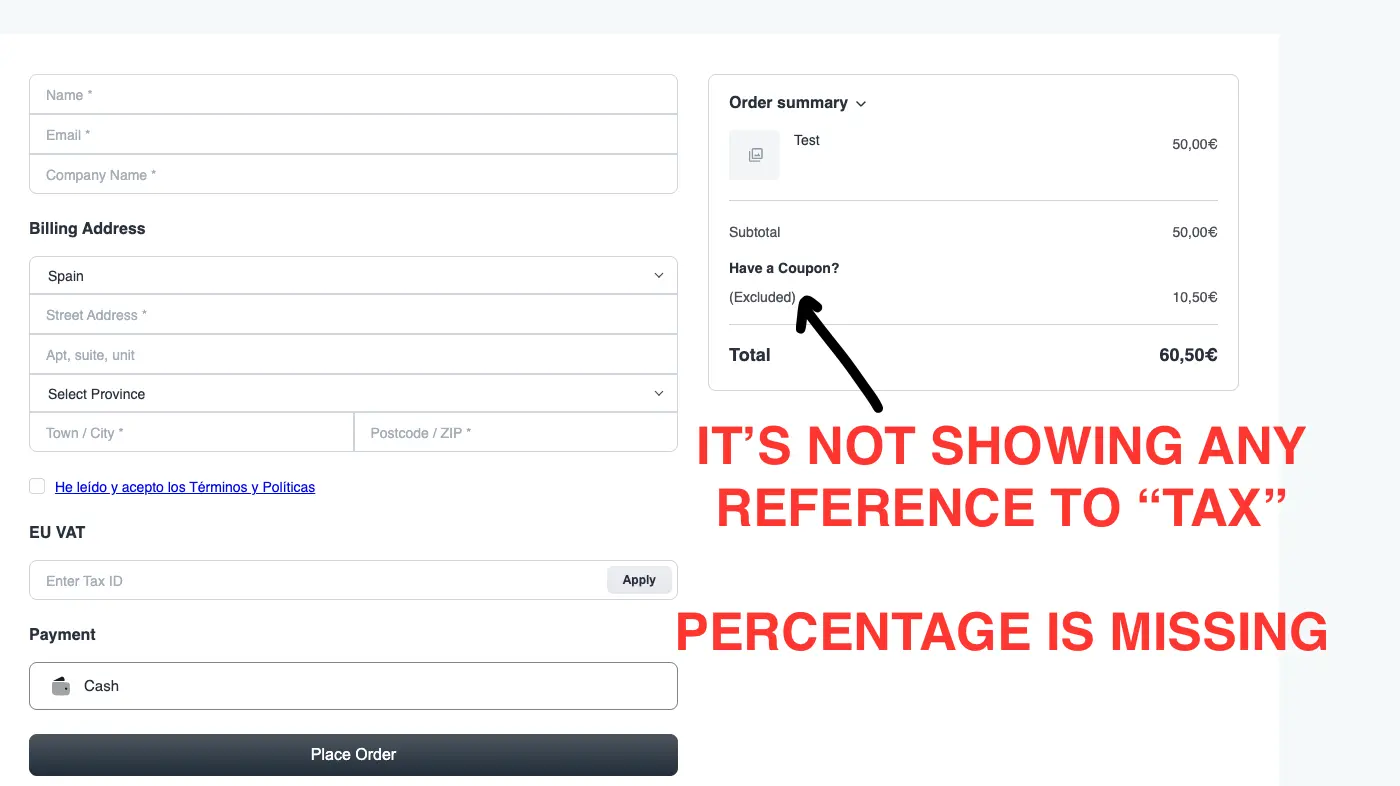
5. Checkout, invoices and receipts do not clearly show the tax name and percentage
Both checkout and generated documents should clearly show:
- the tax name,
- the applicable tax rate,
- the tax amount.
This is important because the same European business may:
- charge local VAT if it remains below the 10,000 € EU B2C threshold,
- use the OSS scheme and charge the customer’s country VAT,
- apply reverse charge for valid EU B2B customers,
- apply no Spanish/EU VAT for non-EU customers.
Using generic labels such as “standard tax”, “reduced tax” or similar is not enough for proper tax documentation.
The tax rate percentage should be visible. This data already seems to exist in the database, so it should also be possible to display it in checkout, invoices and receipts.
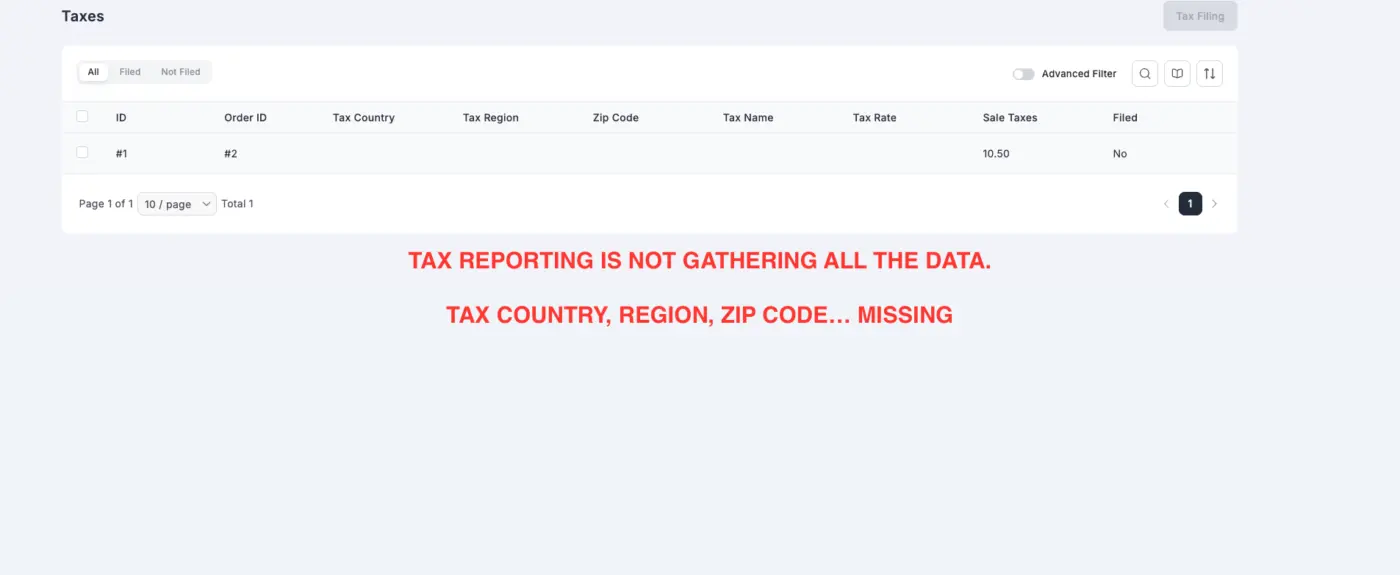
6. Tax reports are not complete enough
In the reports section, especially the tax reports, not all relevant data seems to be reflected correctly.
Some fields appear to be missing even when the customer has entered them, such as:
- country,
- region,
- tax-related customer data.
I will attach screenshots for this.
This matters because tax reports are not just analytics. For many store owners, they are part of their accounting and compliance workflow.
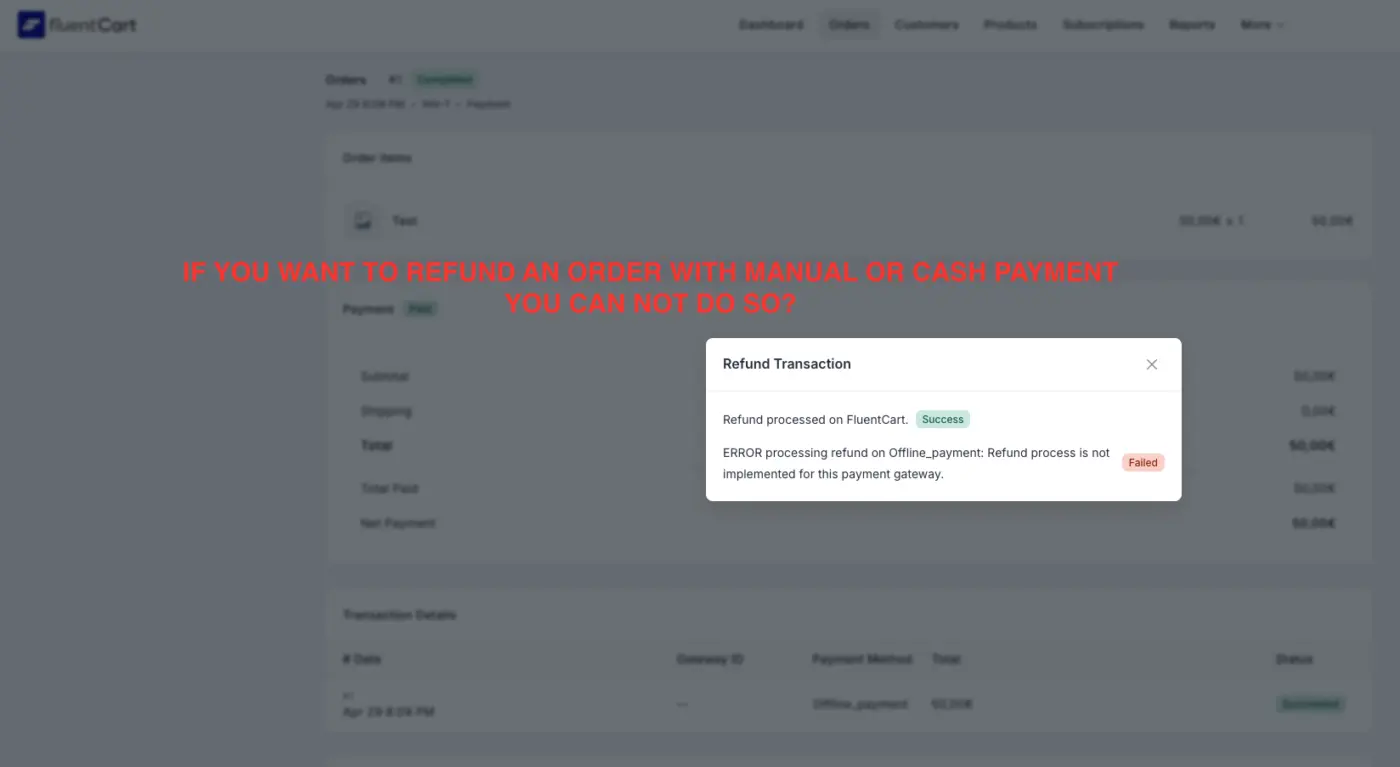
7. Refund error with cash payments
When testing cash payments, I encountered an error when trying to process a refund.
I will attach a screenshot.
This may be an edge case, but cash or manual/offline payments are important for many businesses, especially consultants, agencies and freelancers.
8. Customer lifetime value does not update correctly after refunds
When a refund is processed, the customer lifetime value does not seem to update correctly.
Example:
- Customer buys two products of 50 € each.
- Total LTV becomes 100 €.
- One order is refunded.
- LTV should become 50 €.
At the moment, it seems to remain 100 €.
This creates inaccurate customer reporting.
9. Receipts and invoices are not clearly differentiated in the customer portal and admin
In the customer portal, the CTA says “View receipts”, but when clicking it, invoices appear.
This should be consistent.
A receipt and an invoice are not the same from a tax perspective. In many jurisdictions, including Spain, a receipt cannot be used in the same way as an invoice for tax deduction purposes.
If the document is an invoice, the CTA should say “View invoices”.
Also, in the dashboard and order section, I found it very hard to locate the invoice related to a specific customer order. Ideally, invoices should be accessible directly from:
- the customer profile,
- the order detail page,
- or both.
Right now, I had to go to the customer portal to see how invoices were displayed.
10. Manual orders need tax ID and tax calculation support
Many businesses and freelancers need to create manual orders.
These can be:
- one-time manual orders,
- payment plan orders,
- subscription orders.
There are two important problems here.
First, when creating a manual order, it does not seem possible to enter the customer’s tax ID. As a result, the order is created only with the base product price, without applying the proper tax logic.
This makes manual orders difficult or even unusable for many professionals in the EU.
Second, there does not seem to be an option to update the customer’s tax ID from the customer profile.
In real business operations, this is sometimes necessary. Customers make mistakes, companies change details, or a seller needs to correct billing information before issuing proper documentation.
Final thought
I really want FluentCart to become a strong option for European digital businesses.
The product is moving in the right direction, but tax compliance is one of those areas where small missing pieces can create serious operational and legal friction.
For local sales, international sales, B2B, B2C, EU VAT, non-EU customers, OSS, reverse charge, invoices, receipts and manual orders, checkout and billing flexibility are essential.
I hope this feedback is useful. Happy to clarify anything or share more detailed examples if helpful.
cc: Shahjahan Jewel
P.S. I suspect this may also be reflected, sooner or later, in FluentCart’s adoption in Europe. I know several potential users who are currently holding back because of these issues. Some store owners may only sell within their own country and therefore may not notice the problem immediately. But any online business selling across multiple EU countries, or receiving orders from outside the EU, will eventually face these scenarios. In many cases, they may discover the issue too late, after invoices, receipts or tax reports have already been generated incorrectly. Even businesses that mainly sell locally can receive international orders simply because we operate in a global, internet-based market. In its current state, at least from a documentation and tax reporting perspective, this could create serious compliance problems for those merchants.
- Maxed the amount of screenshots I can upload (<4). Sorry for that :)

Hi,
I noticed FluentCart loads product images in full size (e.g. 1500px+) even when they’re rendered much smaller (~300px). No srcset or WordPress image sizes seem to be used.
I’m using an FSE theme with the FluentCart blocks.
Is this intentional?
And are there plans to support WP thumbnails / responsive images?
This impacts performance, especially on product grids.

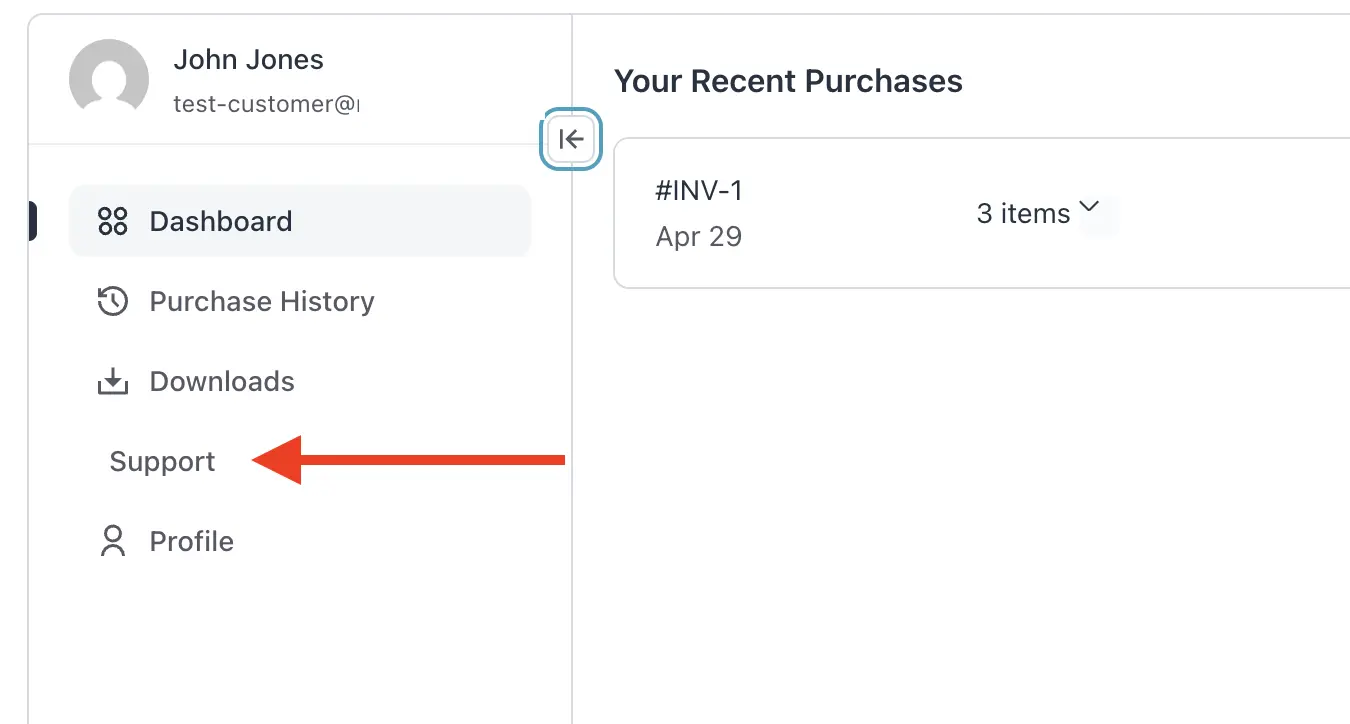
When enabling the Fluent Support "show tab in FluentCart customer dashboard" setting, a tab is added but it lacks an icon:
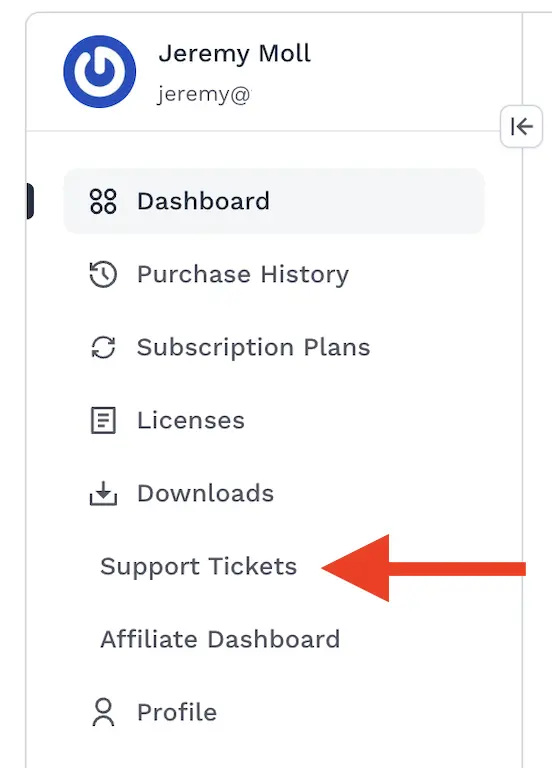
Additionally, on the WP Manage Ninja site's customer dashboard, the tab says "Support Tickets" – it would be great to be able to customize this tab's text without having to use a PHP hook:
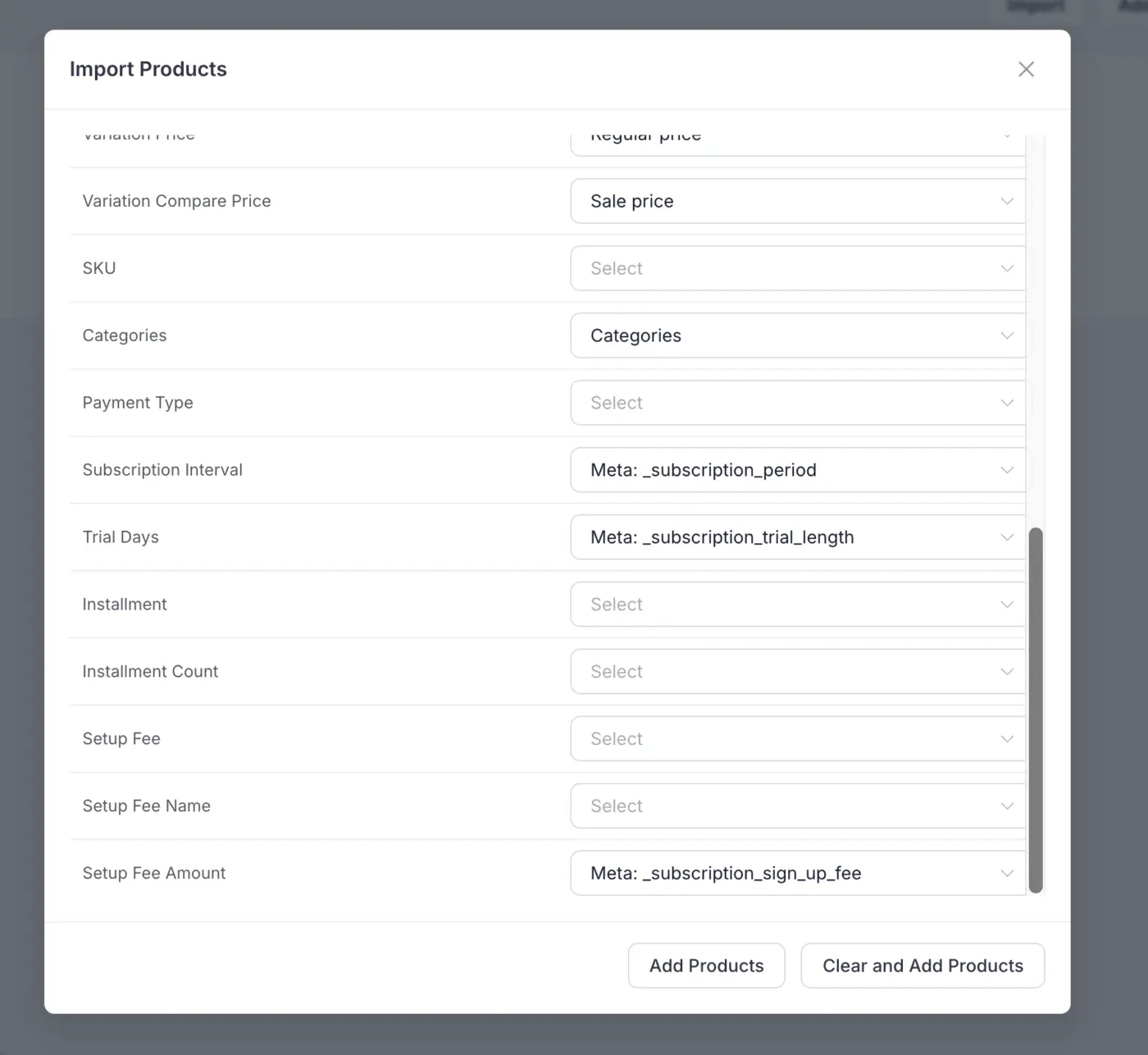
When using the "Import Products" CSV tool in FluentCart, I am unable to clear the select fields on the right. The values in this screenshot were auto-populated by the import tool, and I cannot clear the values (I can only select another value)

Right now, FluentCart elements behave like closed containers. That limits layout flexibility and forces us into predefined structures.
1. Make FluentCart elements nestable
Allow standard Bricks elements (Div, Block, Container, custom HTML, etc.) to be placed inside FluentCart elements.
This would give full control over layout, structure, and styling for:
- Product cards
- Cart items
- Checkout sections
- Order summaries
- Add to cart / Buy now buttons
- Quantity selectors
- Variation selectors (size, color, etc.)
- Checkout forms and fields
These are core UI components, and right now they can’t be composed freely. That makes it difficult to build anything beyond the default layouts.
This nesting pattern is already how Bricks works natively (e.g. Query Loop), and aligning with that would make FluentCart feel like a natural extension instead of a locked system.
2. Expose FluentCart data through Bricks dynamic data
FluentCart data should be available via Bricks dynamic tags, so it can be used anywhere, not only inside FluentCart elements.
For example:
{fc_product_price}{fc_order_total}{fc_customer_name}
This should include:
- Product, cart, order, and customer fields
- Support for building custom loops (products, cart items, orders)
- Conditional logic (e.g. cart empty, user purchased, order status)
Why this matters
These changes remove structural limitations and unlock full design freedom inside Bricks.
Right now, FluentCart has the functionality, but the layout system is the bottleneck.
Open that up, and it becomes viable for fully custom builds instead of only predefined layouts.

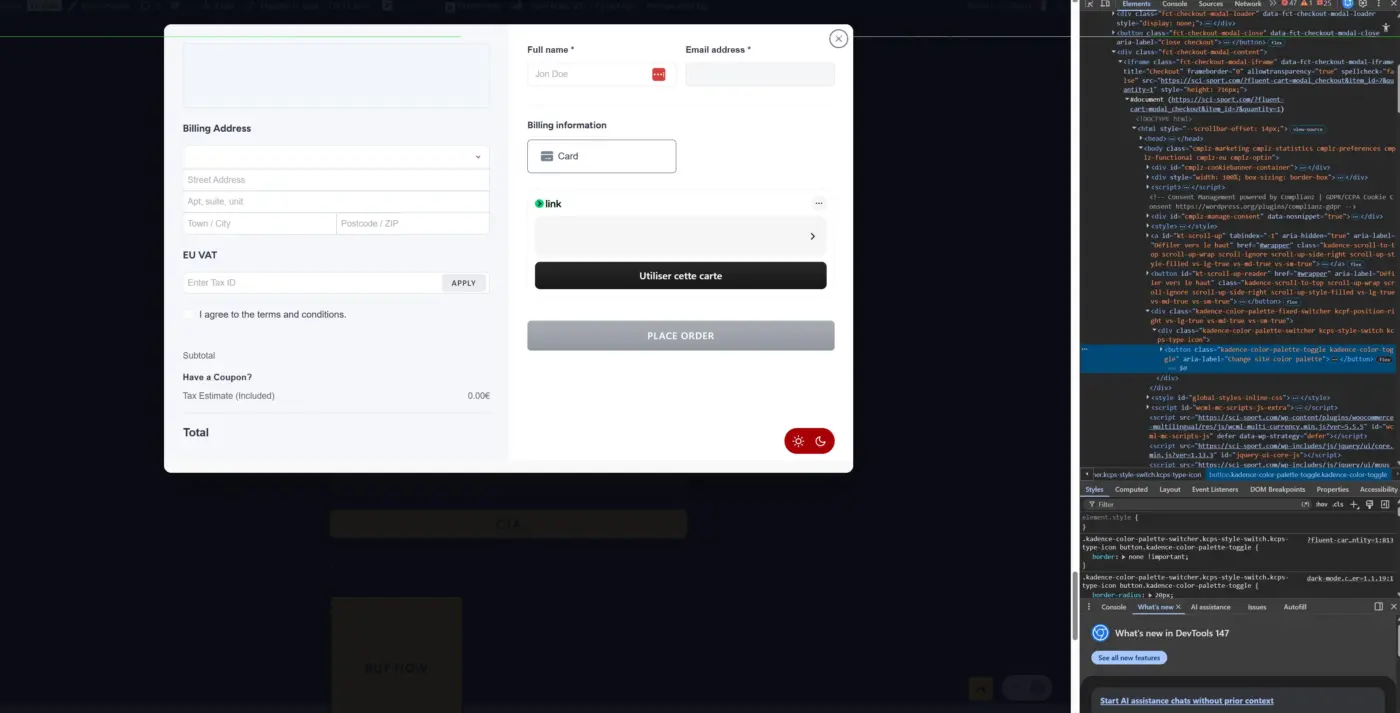
Hi everyone,
I would like to ask about the modal checkout. It's working as expected : a button on my landing page, et voilà, a perfect, quick modal checkout. Love it !
I'm using Kadence Theme, and I'm using the "Dark/Light" switcher as my website is mainly for reading. It's very handful for my students.
BUT... why is the switcher is included in the iframe of the modal. Also, it's not seen on the screen, but I'm using Complianz for cookies and it's also included in the iframe...
So, my question is : is it normal behaviour ? Can it be cleaned (I tried CSS without success) ?
Thanks !

Quick one today.
After the big release week, this update is the kind we wanted to ship next. Mostly polish, a few thoughtful additions, and a long list of fixes that quietly remove friction across the product.
Nothing flashy. Just sharper edges.
Here is what is new in 1.3.23:
- Subscription cancellation emails now show the access end date. Customers know exactly when their access ends instead of guessing. Should cut down on the "do I still have access?" support tickets.
- VAT numbers on PDF receipts. For B2B customers in the EU, UK, and other VAT regions. Drops in cleanly without manual workarounds.
- One-click installer for licensed addons. No more downloading, uploading, activating. Install your purchased addons straight from inside FluentCart.
- LearnDash course expiration is tied to subscriptions and licenses. Course access now follows the billing lifecycle. When the subscription ends, course access ends. No more drift.
Plus a few smaller wins: Paddle email control via filter hook, cleaner product card styling, and a solid stack of fixes, including license grace period status, downloads after a site URL change, PHP 8.4 timezone handling, dark mode empty states, and a bunch of papercut fixes across checkout, reporting, and license delivery.
If you sell subscriptions, licensed software, or B2B in VAT regions, this update is worth grabbing today.
Full changelog with details: https://fluentcart.com/blog/fluentcart-1-3-23/
That is it for now. More fun things cooking 👀

{reducted image}