

FluentCart feedback: EU VAT, tax IDs, invoices and reporting gaps
TL;DR:
FluentCart is moving in the right direction, and the recent improvements around EU VAT/VIES validation are very welcome. It is clear that the team is putting a lot of care and attention into the product. Congrats!
However, I still cannot openly recommend it to many European digital businesses because there are important gaps around tax ID collection, VAT display, reverse charge wording, invoices/receipts, tax reports, refunds and manual orders.
These issues may not be obvious for merchants selling only inside their own country, but they become critical for businesses selling across the EU or internationally.
I really hope this feedback helps close some of those gaps.
Hi Jewel and team,
First of all, I’m happy to see the progress FluentCart is making. I have been testing it again from the perspective of European digital businesses that sell both locally and internationally, including B2B, B2C, EU and non-EU customers.
I will attach screenshots with specific examples, but I wanted to organize the main feedback here.
1. Checkout fields still need proper custom fields
Checkout fields still do not allow proper custom fields.
This is especially important for tax compliance. The Tax ID should be available as a required field by default, or at least easy to add next to the billing address fields.
The current EU VAT field helps when the customer is an EU business, but it does not solve the broader issue.
For example, a French store may sell to:
- a French company,
- a German company,
- a Spanish company,
- a US customer,
- a Canadian customer.
In the EU cases, the EU VAT field may apply. But for non-EU customers, the store may still need to collect a local tax ID, company registration number or equivalent fiscal identifier.
SureCart, for example, solves this with a single dynamic “Tax ID” field. Depending on the customer’s country, it can collect the relevant identifier.
Right now, unless I have missed something, FluentCart does not seem to offer a default way to request a tax ID outside the EU VAT configuration. This is a serious limitation for international compliance.
2. Price formatting should allow clean round numbers
This is not a major compliance issue, but it matters for UX and conversion.
If a product costs 50 €, some businesses may prefer to display it as:
50 €
instead of:
50,00 €
It would be useful to have an option to hide decimals when they are not needed.
3. EU VAT validation sometimes feels slow or unstable
When testing EU VAT numbers several times in a row, validation can take quite a while.
I also experienced a “Max concurrent request” error after entering VAT numbers two or three times in a row.
I understand this is not normal customer behavior in most cases, but it can happen with businesses managing different entities or establishments.
It would be useful to improve reliability, caching or user feedback around VIES validation.
4. “Reverse charge (No tax)” is confusing
I’m glad to see that FluentCart now references “Reverse charge” when an EU business enters a valid EU VAT number.
However, the wording “Reverse charge (No tax)” is not ideal.
The issue is the “No tax” part.
In a reverse charge scenario, the seller does not charge VAT to the customer, but this is not simply a “no tax” transaction. There is still a VAT treatment, and the buyer may have to account for VAT locally under the reverse charge mechanism.
The phrase “No tax” can confuse both sellers and buyers. I have already seen this create doubts in Spain and other EU member states.
I am not asking FluentCart to include the specific legal article in every case, because I understand this can vary depending on the country, product or service. But I do think “No tax” should be removed.
A safer wording would be simply:
Reverse charge
or:
Reverse charge applies
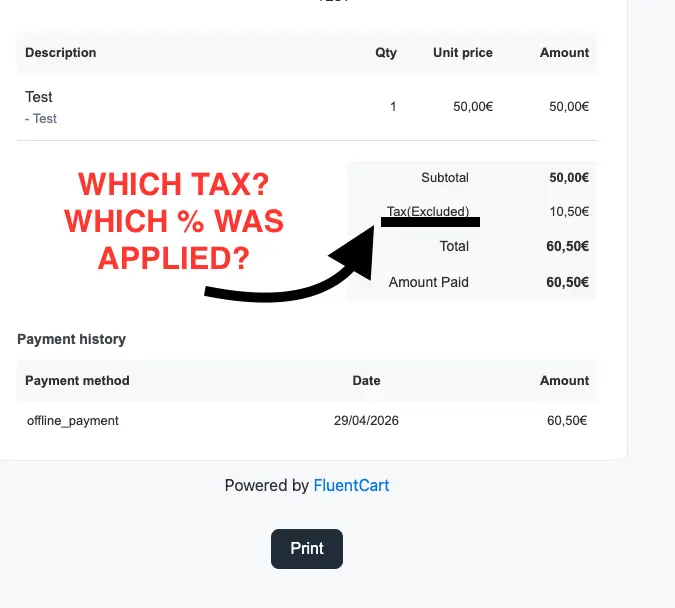
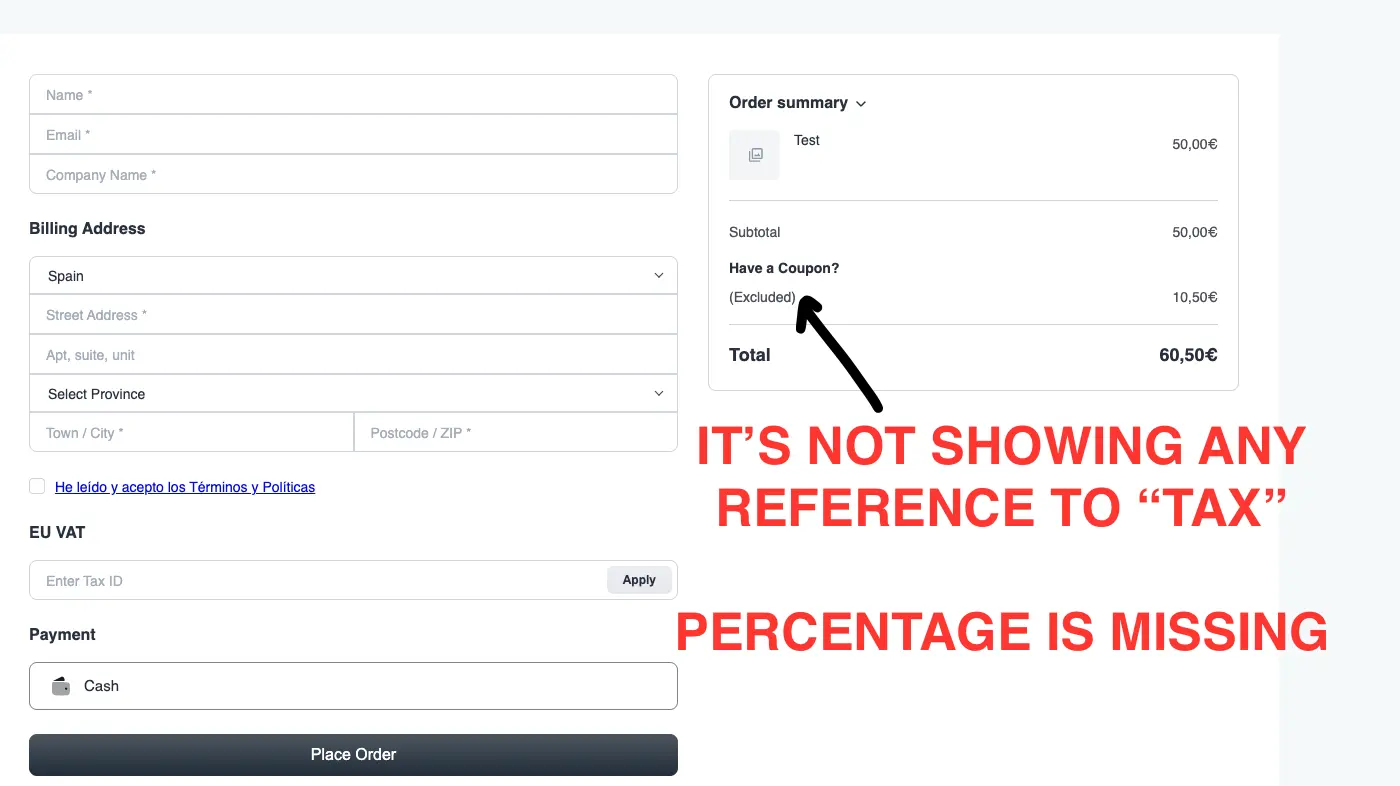
5. Checkout, invoices and receipts do not clearly show the tax name and percentage
Both checkout and generated documents should clearly show:
- the tax name,
- the applicable tax rate,
- the tax amount.
This is important because the same European business may:
- charge local VAT if it remains below the 10,000 € EU B2C threshold,
- use the OSS scheme and charge the customer’s country VAT,
- apply reverse charge for valid EU B2B customers,
- apply no Spanish/EU VAT for non-EU customers.
Using generic labels such as “standard tax”, “reduced tax” or similar is not enough for proper tax documentation.
The tax rate percentage should be visible. This data already seems to exist in the database, so it should also be possible to display it in checkout, invoices and receipts.
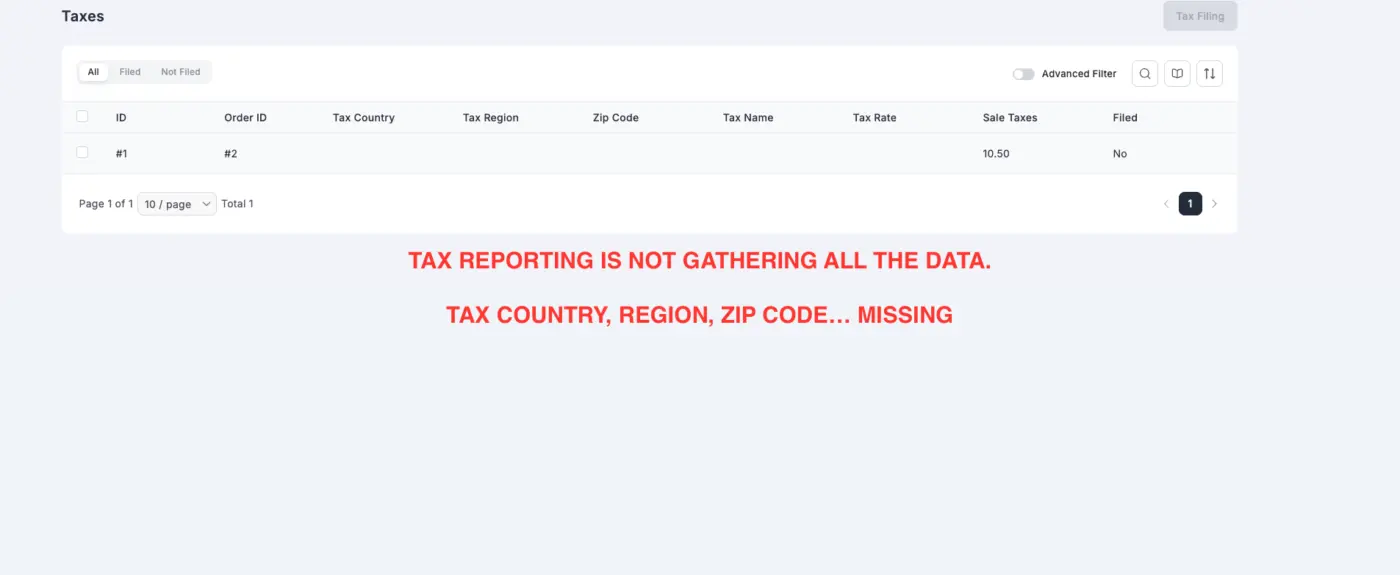
6. Tax reports are not complete enough
In the reports section, especially the tax reports, not all relevant data seems to be reflected correctly.
Some fields appear to be missing even when the customer has entered them, such as:
- country,
- region,
- tax-related customer data.
I will attach screenshots for this.
This matters because tax reports are not just analytics. For many store owners, they are part of their accounting and compliance workflow.
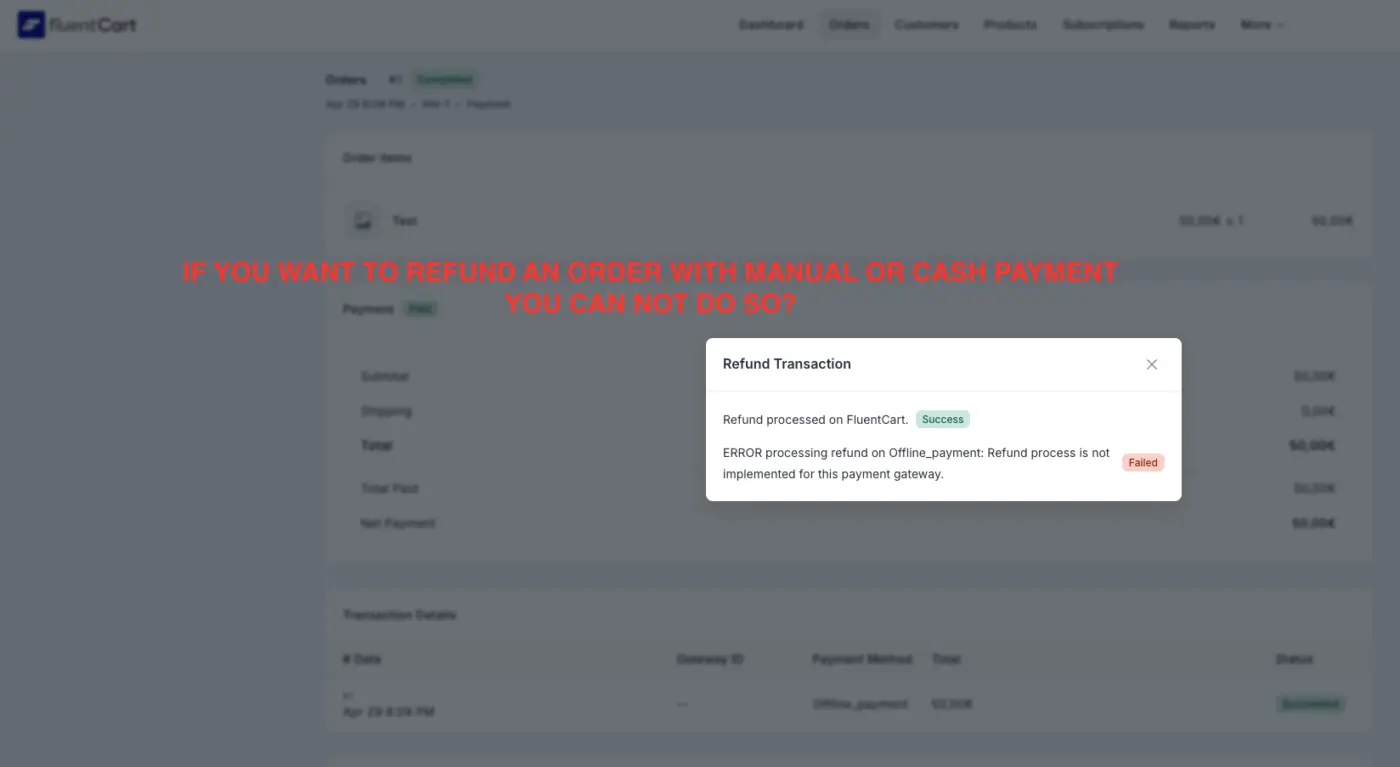
7. Refund error with cash payments
When testing cash payments, I encountered an error when trying to process a refund.
I will attach a screenshot.
This may be an edge case, but cash or manual/offline payments are important for many businesses, especially consultants, agencies and freelancers.
8. Customer lifetime value does not update correctly after refunds
When a refund is processed, the customer lifetime value does not seem to update correctly.
Example:
- Customer buys two products of 50 € each.
- Total LTV becomes 100 €.
- One order is refunded.
- LTV should become 50 €.
At the moment, it seems to remain 100 €.
This creates inaccurate customer reporting.
9. Receipts and invoices are not clearly differentiated in the customer portal and admin
In the customer portal, the CTA says “View receipts”, but when clicking it, invoices appear.
This should be consistent.
A receipt and an invoice are not the same from a tax perspective. In many jurisdictions, including Spain, a receipt cannot be used in the same way as an invoice for tax deduction purposes.
If the document is an invoice, the CTA should say “View invoices”.
Also, in the dashboard and order section, I found it very hard to locate the invoice related to a specific customer order. Ideally, invoices should be accessible directly from:
- the customer profile,
- the order detail page,
- or both.
Right now, I had to go to the customer portal to see how invoices were displayed.
10. Manual orders need tax ID and tax calculation support
Many businesses and freelancers need to create manual orders.
These can be:
- one-time manual orders,
- payment plan orders,
- subscription orders.
There are two important problems here.
First, when creating a manual order, it does not seem possible to enter the customer’s tax ID. As a result, the order is created only with the base product price, without applying the proper tax logic.
This makes manual orders difficult or even unusable for many professionals in the EU.
Second, there does not seem to be an option to update the customer’s tax ID from the customer profile.
In real business operations, this is sometimes necessary. Customers make mistakes, companies change details, or a seller needs to correct billing information before issuing proper documentation.
Final thought
I really want FluentCart to become a strong option for European digital businesses.
The product is moving in the right direction, but tax compliance is one of those areas where small missing pieces can create serious operational and legal friction.
For local sales, international sales, B2B, B2C, EU VAT, non-EU customers, OSS, reverse charge, invoices, receipts and manual orders, checkout and billing flexibility are essential.
I hope this feedback is useful. Happy to clarify anything or share more detailed examples if helpful.
cc: Shahjahan Jewel
P.S. I suspect this may also be reflected, sooner or later, in FluentCart’s adoption in Europe. I know several potential users who are currently holding back because of these issues. Some store owners may only sell within their own country and therefore may not notice the problem immediately. But any online business selling across multiple EU countries, or receiving orders from outside the EU, will eventually face these scenarios. In many cases, they may discover the issue too late, after invoices, receipts or tax reports have already been generated incorrectly. Even businesses that mainly sell locally can receive international orders simply because we operate in a global, internet-based market. In its current state, at least from a documentation and tax reporting perspective, this could create serious compliance problems for those merchants.
- Maxed the amount of screenshots I can upload (<4). Sorry for that :)

Great feedback. My hope is that you also emailed this directly to support to guarantee they saw this. Too useful to miss these recommendations.

Everard Brockett Thanks Everard. Yes, totally agree. The team has already seen it, but I’ll also make sure the key points are shared directly so they don’t get lost in the community thread.

Jorge de los Reyes thanks for bringing this to attention again 🙂
It would also help if the checkout block fieldlabels could be editable.
For example the order button, in Belgium it is not sufficient to display 'order', it specifically needs to say 'pay now' or 'subscribe now' Shahjahan Jewel
Natascha Vantuykom Exactly, Natascha. Editable checkout labels are not just a translation issue, they can be a legal compliance issue too.
In the EU, the final button should clearly tell the customer that placing the order creates a payment obligation. So being able to use wording like “Pay now”, “Subscribe now” or the legally appropriate equivalent in each country would be very useful.
Btw, I was very happy to see Peppol references in the tax and e-invoicing section. I’m pretty sure someone here influenced that quite a lot! 😄👏
Hopefully we’ll see VERI*FACTU there someday too 🫣
Jorge de los Reyes yes indeed, but there is little info on how to use this e-invoicing. We are just able to enable it, but can not check wat it actually does
Natascha Vantuykom I guess it’s setting a layer of the ISO requirements for the formats.
Sadly, I do not think it’s a layer for connecting to the compulsory tax authorities systems.
I think we will need to go deeper into the docs about this 😅.
Let’s the party begin 🫣: in Spain we still have 1 year left. How is everything going in Belgium?
Jorge de los Reyes we officially moved to mandatory PEPPOL on January 1st 2026, but had a grace period until March 30 2026.
I'm glad we created the https://peppolcommerce.eu e-invoicing plugin. It works with FluentCart and Woocommerce (thanks to Mahmudul Haque 🙂) and creates a compliant Peppol invoice from orders, and send it through the peppol network automatically. The pdf-version can be generated too for people who like this
Natascha Vantuykom trailblazers :)

Thank you for this detailed feedback, much appreciated !

Thank you for representing EU businesses, Jorge de los Reyes -- your feedback is always thorough, actionable, and relevant. I couldn't agree more that it's not a question of UI/UX, it's a question of consequential legal compliance. We're all excited and eager to see FluentCart (and the entire Fluent ecosystem) enjoy rapid and broad adoption in the EU. Keep up the great work!
Paula Thank you so much, Paula. I really appreciate it.
For EU businesses, compliance is not a “nice to have” or a UX preference. It directly affects whether a store can safely use the product in production.
I genuinely want FluentCart to succeed in Europe. The potential is huge, especially because the Fluent ecosystem already solves so many operational pieces for small businesses. If the legal/compliance layer is solid from the start, adoption here will be much easier. Specially if everything is ready prior to the upcoming e-invoicing requirements.
Happy to keep contributing practical feedback from the EU side.
